
Dylan’s In the Basement Mixing Up a Masterpiece
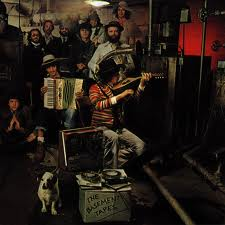
The Basement Tapes
Bob Dylan and The Band
1975
Back before everybody started converting them into “man caves”, wine cellars and S&M dungeons, nobody cared much about the average American basement. Unless you blew a fuse or your hot water went cold, the basement was an afterthought. They were poorly lit holes in the ground, booby-trapped with wiring, plumbing and heating ducks that could be downright dangerous if you didn’t watch your step. Damp and dirty, the basement wasn’t even good for storing most things.
But if you wanted to start a rock band in the 60s or 70s, the cellar was usually up for grabs and your best option. That’s why so many musicians started out playing underground and why they never seem to lose their affinity for the privacy and isolation you can find in a basement. For a lot of musicians, going down into the basement is like going back in the womb.
So it shouldn’t surprise us that Bob Dylan and the Band’s Basement Tapes, recorded in 1967 and officially released in 1975 after years of bootlegging, contains some of their most relaxed and enduring music. Discussing the sessions with Rolling Stone’s Jann Wenner back in 1969, Dylan said, ” They were just fun to do, that’s all.” “They were a kick to do. Fact, I’d do it all again. You know… that’s really the way to do a recording – in a peaceful, relaxed setting – in somebody’s basement. With the windows open… and a dog lying on the floor.”1
The 24 tracks collected on the Basement Tapes were recorded in the cellar of a rental home nicknamed Big Pink, after the color of its siding. The Band’s Garth Hudson, Rick Danko and Richard Manuel rented the house, having followed Dylan up into the mountains near Woodstock, NY after finishing a tour as his backing band (billed as The Hawks). Dylan and Robbie Robertson were already living nearby.
After years of nonstop writing, recording and touring, Dylan badly needed a break at the time. Unfortunately, that break involved the bones in his neck, the product of a serious motorcycle crash in 1966. Shaken by the fall and overwhelmed by the pressure of being the “voice of his generation,” this accident led to a period of withdrawal from the public eye, as he convalesced at home and reflected on what to do next.
The respite from touring and crisp mountain air agreed with Dylan and helped refresh his muse. Though semi-retired as a social activist, he was still writing at a breakneck pace. As the ideas and inspiration gathered momentum, Dylan and the Band started recording rough demos of his new songs with a few microphones and some basic recording gear. In most cases these were songs Bob Dylan never intended to release under his own name, and several had already become hits for other artists before The Basement Tapes were finally released. In all, more than 100 song were recorded in the basement at Big Pink, although many were cover versions of traditional folk, country and blues songs.
Dylan’s original songs, with a few notable exceptions (This Wheel’s on Fire and Tears of Rage), were quite unlike any of his best known compositions. These were short, sturdy little songs about small town American life. Dylan’s characters were often simple folk, living slowly and reflecting on the most ordinary activities you could imagine. Consider this dialogue from one of my favorites, “Clothes Line Saga.”
The next day everybody got up
Seein’ if the clothes were dry
The dogs were barking, a neighbor passed
Mama, of course, she said, “Hi!”
“Going to Acapulco” examines a rogue’s bitter mix of regret and a resolution, as the self loathing narrator decides to run from his past to the sunny beaches of Mexico. On “Please Mrs. Henry” Dylan comically begs for a toilet, addressing a pissed off landlady or barmaid, when he sings
Now, I’m startin’ to drain
My stool’s gonna squeak
If I walk too much farther
My crane’s gonna leak
It was as if Dylan was conjuring a bygone time and place and inhabiting that world vicariously; through the simple, lighthearted characters he created out of thin air. This was his escape. This was his response to the pressure of being Bob Dylan.
Eight tracks on The Basement Tapes were written, played and sung by the Band without Dylan, but the difference is subtle. Essentially, you’re hearing the same band, instruments and arrangements with some different lead vocalists. While not quite as whimsical as many of Dylan’s tunes, the Band’s solo tracks keep pace with the quality of their mentor’s compositions. If anything The Band sound like they’re trying a little harder. Like they have something to prove. If you’ve never heard this record before, Richard Manual’s “Katie’s Been Gone” will steal your heart, just like she stole his. This is a song written before the cell phone and before we were always connected. It explores the helpless feeling of loneliness and separation in a way that’s hard to imagine anymore, unless you happen to be listening to this song.
Few bands ever boasted the individual talent of The Band. For starters, The Band featured three strong lead vocalists in Rick Danko, Levon Helm and Richard Manual, with Helm belting out the heavier songs, Manuel singing the ballads in his sweet falsetto and Danko taking the lead on everything in between. But beyond the vocals they were superb musicians who played to each others strengths, to create a uniquely American version of rustic, backwoods rock and roll.
Like so many great rock and roll records the music feels confident, but unrehearsed, loose and natural. Even the arrangements seem spontaneous, with some songs featuring only a few acoustic instruments and keyboards, and others played with the full complement of drums, bass and electric guitars. You can almost picture Robbie Robertson walking in mid-track, grabbing a guitar off the floor and laying down a few off-the-cuff licks just for the hell of it. The whole thing sounds like a musical version of pick up basketball. If you happened to be there and felt like playing, you grabbed an instrument.
Sometimes the place where a musician decides to record can have a big impact on what ultimately winds up on the tapes. The basement at Big Pink allowed Bob Dylan and the Band to work in obscurity, on their own terms and at their own pace. They wrote and recorded for no particular reason; for the joy of it, for the hell of it, sometimes for the lack of anything else to do. In the process they created a collection of timeless songs, likely to offer as much pleasure to their listener 38 years from now as they did 38 years ago.
If you want to be notified of new posts, like my Facebook page at Just Riffin’ or follow me on twitter @JiminyPage. Thanks!
Wenner, Jann. “Interview with Jann S. Wenner,” Rolling Stone, November 29, 1969, in Cott 2006, p. 143
 Brian loves South Jersey for its proximity to four metropolitan cities, the Jersey shore, the Pocono Mountains and some of the nation's most congested roadways. When he's not marketing education, or on a treadmill, BK spends most of his free time spinning vinyl, writing and playing guitar. Brian writes a classic rock blog at Justriffin.com and edits Planet Zombo.
  Just Riffin'
Excellent post.
Hi and thank you very much. Glad you enjoyed the post. Please let others know if you enjoy my writing. I’ll be sure to do the same.